School Sucks: Think Outside the Classroom
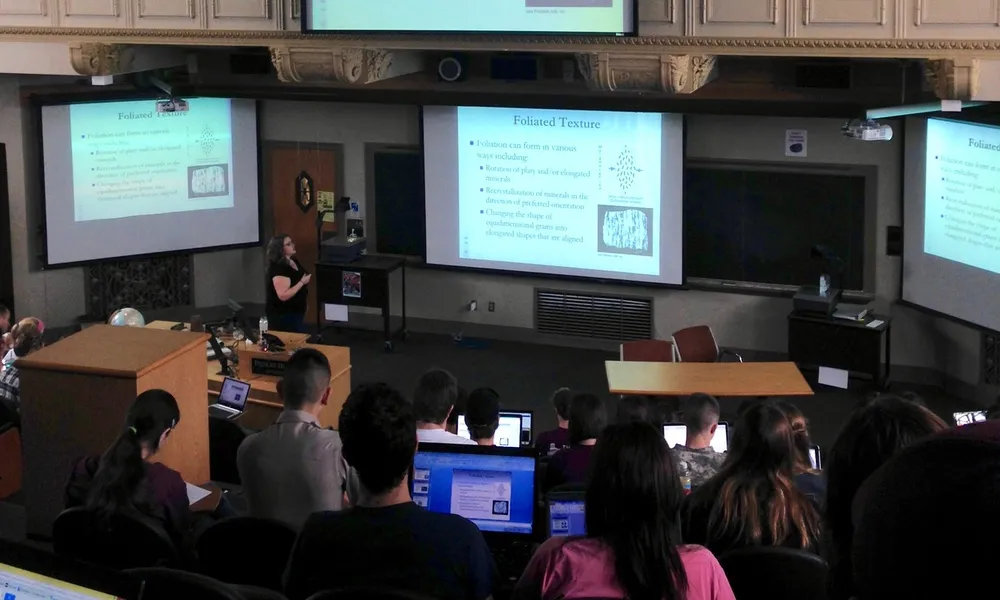
I haven’t been paying attention the entire lecture. Feeling disrespectful, I take a moment to glance up from my laptop. The professor is going on listlessly. I can barely hear him. Half-a-billion-years-old fossils gleam dully on the projector screen.
Trying to pay attention only reminded me why I wasn’t listening in the first place. Frankly, it’s boring, and boringly presented. It’s the sort of material I might enjoy reading about in a clever online article, or maybe even a Wikipedia entry; but it feels unproductive, even painfully wasteful, to sit through an hour-long lecture — let alone three times a week.
As I stifle my restlessness, it occurs to me that I’m paying for this. In fact, you’re probably paying for this too. Our entire society is paying for this, and paying a lot — taxation, tuition, and donations; scholarships and loans. And for what?
“Education,” we say reverently; but I cannot help but question the sacrosanct synonymity between school and education. Are they the same thing? Education is learning, and school is for learning, right? But is this really a good way to learn?
We regard our university system as so essential and permanent that we compel nearly half of its funding through the force of government. There’s an ongoing push to go all the way and socialize it completely — to make college “free for all.” But I wonder if further propping up this system is really in everyone’s best interests; and whether the goal of education might be met some other way.
Scanning the lecture hall from my perch in the rear, I guess that only half the class is in attendance. This is hardly a surprise; I myself haven’t attended this class in weeks. Of those who did make it, most are engrossed in their phones or laptops — shopping online, browsing through social media feeds, or doing homework for other classes.
The truth is, it’s not worth paying attention. It’s not even worth showing up. The lecture slides are posted online, and they’re all you need to prepare for the exams and pass.
In-person education used to make more sense. Before the introduction of the printing press five centuries ago, education usually meant lessons with a private tutor or attending a school or university. Specialized knowledge demanded personal instruction or access to rare texts. Back then, societies lacked the resources, manpower, and technology needed to teach all but a privileged handful of students. Besides, scribes simply couldn’t copy words fast enough to widely diffuse information.
That hasn’t been true for a while. With printed books, we can learn from the world’s brightest people as fast as we can read, and cheaply. And if the innovation of the printing press alone hasn’t rendered lecture-based learning obsolete, now we have the Internet.
With the Internet, any answer is a search away. The best articles and lectures, the world’s most knowledgeable, most entertaining, and most talented presenters of information, all compete for attention in an online marketplace of ideas. On the Web you’ve got podcasts, videos, blogs, encyclopedias, and ebooks. Entire curriculums are offered online, with courses ranging in focus from web design and computer programming to writing or finance or cooking.
All of this can be found for free.
More and more students doze or fidget through class, knowing they can catch up by browsing free material online. Can we seriously discuss the problems in our university system without noticing these alternatives?
Indeed, most of my classmates are playing around online now, even though they’re paying to be at class. The professor has to realize that most of his students didn’t bother to show up, and most who did aren’t even listening. Yet he forges onward, apparently undeterred.
Does he feel disrespected, I wonder, or like he’s wasting his time? Is he used to it by now? And the students — why are we okay with going into debt for this, losing sleep over this, or even spending time on it at all?
Is it possible that we lack the imagination and objective thinking we’d need to detach ourselves from a system we’ve always known — that our parents and grandparents have always known — to question these methods of learning? Are we slaves to social norms?
Surely we aren’t all paying through our noses for an education of dubious value, conducted like the schools of the Ancient Egyptians, when cheaper and more effective alternatives are available. Right?
Abruptly, the professor mentions that there will be no class on Friday, since he has some other commitment. A cheery murmur rolls through the lecture hall. Students grin at one another, grateful for a reprieve.
But something’s wrong here. When you’re happy that a service for which you’re paying dearly is canceled, even though you aren’t going to be refunded, something isn’t right. The incentives are off. Is it possible that my peers don’t care about the fossils or the rocks, or at least don’t think these lectures are the best way to learn about them?
This is not to say that lecture-style learning doesn’t have its place. But we shouldn’t pretend it’s for everything and everyone.
I want to learn about history and current events; about how to handle money and finances; about how our economy works. I want to learn about health and its optimization, and how to develop software, and how to cook, and everything else. And between friends, books, and the Internet, I can learn about these things, and do — on my own time.
At school, I’m on my laptop during lectures, cramming into my head enough information about fossils to get good grades. Only afterwards do I get to teach myself what I find valuable.
I don’t think that’s pessimistic. It’s pragmatic. I’m pleasantly surprised when I learn something interesting or useful through school, and gain a shred of trust in the system.
Then I remember how I spent half of Saturday writing an essay about a computer program that will only ever be read by a tired graduate student, and how I spent too much of Sunday staring at slideshows of rocks. And then I lose faith again.
Now, learning about rocks isn’t without its value. I’m glad we’re wealthy enough as a society to spend our limited energy and resources exploring subjects like geology. But I could cover the same material faster, more cheaply, more entertainingly — at my own pace, when I’m actually curious about it. Or skip it and spend that time on something more relevant to me or my career.
“Don’t let your schooling interfere with your education,” runs one rendition of a well-known line. The implication, of course, is that school can inhibit learning.
That line, in various forms, is sometimes associated with Mark Twain, who died over a hundred years ago. Since then, universities have become not only more bloated and wasteful in both time and resources, but also less relevant. But because the system has been around so long, and because we’ve all been raised in it, it’s difficult to think beyond it.
We take for granted an upbringing occupied by lectures and tests, and shaped by an artificial culture of grades, cliques, and classrooms. We see it as normal — the path to success, or perhaps a tedious social necessity.
I challenge you to question these assumptions. Disentangle education from school. Consider the extent to which the system stifles us — has stifled you — and imagine the alternatives that might take its place. Computer technology in particular has revealed the inadequacy of conventional education, but the problem runs deeper than lagging behind innovation.
Why is school so expensive? What incentives bring us to it in spite of its costs and inefficiencies, and what puts them in place? Is further subsidizing the system really progress, or is it just prolonging a fundamental problem?
The professor is still talking. I’m considering slipping out the back.